Every November, the same question lands in our DLOOK Fashion Editor Team inbox: "I have one coat-sized hole in my budget this Black Friday — which style do I buy?" It's the single biggest single-item purchase most women make all season, and it's also the one with the worst returns. Buy the wrong coat and you'll either freeze in a "fashion" trench or look like you're wearing a sleeping bag to dinner.
This guide decodes the six winter coat styles that actually matter in 2026 — wool overcoat, puffer, trench, peacoat, parka, and shearling (plus its kinder faux-fur cousin). For each one, we break down how to recognize a good one, how warm it really is, which body types and heights it flatters most, and what you should realistically pay — including what a genuine black friday coat sale discount looks like versus a fake "markdown" on an inflated original price. If you're building a whole winter wardrobe around your coat this year, you can also see the full $500 Black Friday capsule wardrobe challenge (12 pieces, 48 outfits) — the coat you pick here is the anchor piece of that entire plan.
Search interest in "winter coat" spikes to its absolute annual peak during Black Friday week — and in 2026, according to Google Trends data, the climb started unusually early, in mid-September. That means retailers are already discounting, and the best winter coat deals of the season are landing earlier than they used to. Here's everything you need to decide before you click "add to cart."
How We Built This Guide
We evaluated each coat style across four dimensions: construction and fabric quality, real-world warmth (not just the marketing temperature rating), fit across heights from petite to plus size, and the price-to-quality ratio at every budget tier. Our editors cross-referenced current collections and editor picks from major fashion publications including Harper's Bazaar, and we fact-checked the history and terminology of each style against reference entries on classic coat types. Every style note below is written to help you recognize quality in a product photo — because that's where most of us actually shop now.
The 6 Winter Coat Styles at a Glance
The Wool Overcoat — the polished investment piece. Warmth: 4/5. Best for: everyone, especially if you buy one coat only.
The Puffer — the warmest option per dollar. Warmth: 5/5. Best for: cold commutes, campus life, and anyone who runs cold.
The Trench Coat — the year-round classic. Warmth: 2.5/5. Best for: mild winters, layering, and transitional weather.
The Peacoat — the compact heritage style. Warmth: 3.5/5. Best for: petite frames and anyone who finds long coats overwhelming.
The Parka — the weatherproof workhorse. Warmth: 5/5. Best for: wet, windy, truly cold climates.
The Shearling / Faux Fur Coat — the statement texture. Warmth: 4/5. Best for: evening dressing and cozy maximalism.
1. The Wool Overcoat: The One That Pulls Everything Together
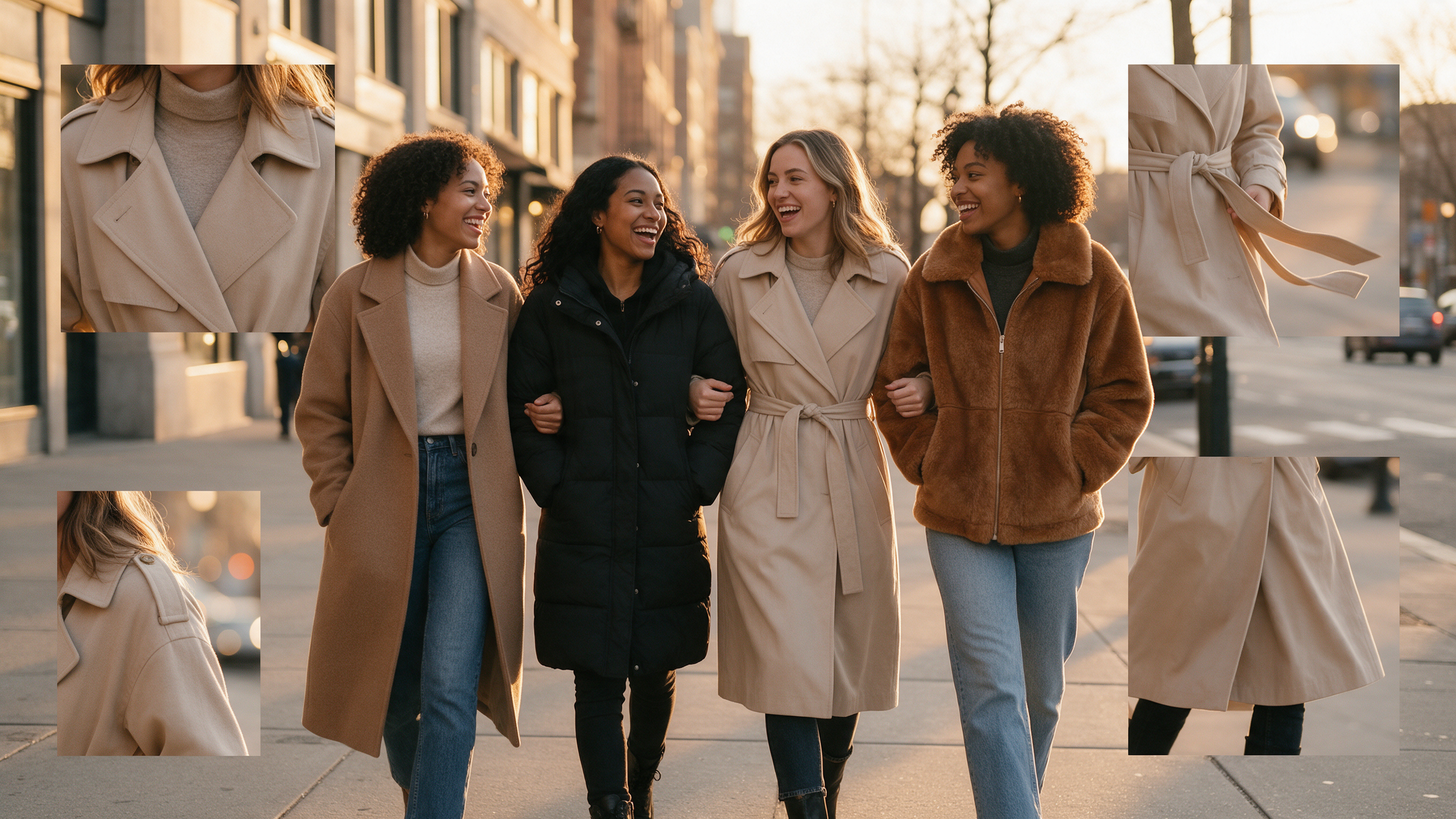
If winter coat styles were a family, the wool overcoat would be the eldest sibling everyone quietly relies on. Cut straight or slightly oversized, usually single- or double-breasted, and finishing anywhere from mid-thigh to below the knee, it's the coat that makes jeans-and-a-sweater look intentional and lets a party dress arrive properly.
How to recognize a good one: Check the fabric content, not the marketing copy. You want a minimum of 60–80% wool; "wool-blend" coats that are mostly polyester pill within one season and won't hold their shape. The shoulder seam should sit exactly at your shoulder bone (drop-shoulder oversized cuts excepted — and if you go oversized, size down one). Look for a full or half lining in viscose or cupro, not polyester, which traps static. A well-made overcoat has bound seams inside, a hanging loop, and a hem that hangs evenly when you hold it up.
Warmth: 4 out of 5. Wool is a natural insulator that keeps working even when damp, and a knee-length cut protects more of your body than any hip-length style. In the 25–40°F (-4–4°C) range — the classic "cold but not brutal" city winter — a wool overcoat over a sweater is genuinely sufficient. Below that, you'll want a chunky knit layer underneath.
Best body types and heights: This is the most universally flattering category, which is why it anchors most capsule wardrobes. If you're petite (under 5'4"), choose a coat that ends just above or at the knee rather than mid-calf — the longer the coat, the more it visually shortens your leg line. Taller and plus-size frames can carry the dramatic full-length versions beautifully; a defined waist belt keeps volume from overwhelming your shape. For curvy figures, a single-breasted style with a deep V lapel creates a long, clean vertical line.
Budget: $120–250 gets you a solid high-street wool-blend (60% wool) that will last 3–5 seasons. $300–600 is the sweet spot for 80%+ wool, half-canvas construction, and better tailoring. $800+ buys designer cuts and cashmere blends — lovely, but the mid-tier is where the value lives.
And a note on the color: camel is the classic for a reason — it pairs with black, navy, grey, cream, denim, and every jewel tone. If you already own black, camel is your second overcoat.

Caption: The camel wool overcoat is the hardest-working piece in a winter wardrobe — polished enough for coffee meetings, warm enough for the walk home.
2. The Puffer: Maximum Warmth, Minimum Fuss
The puffer has fully graduated from ski-lift utility to legitimate street style, and in 2026 it's one of the strongest trend signals in outerwear — cropped, long, belted, and in saturated colorways that read more "fashion editorial" than "ski rental." But the core promise hasn't changed: nothing keeps you warmer per dollar.
How to recognize a good one: Two numbers matter: fill power and fill weight. Fill power (550–900) measures loft — the higher the number, the more warmth per ounce. Fill weight tells you how much insulation is actually inside. A "900-fill" jacket with 60 grams of fill is a fashion piece; a 650-fill jacket with 250 grams is a serious winter coat. Check for a windproof outer shell (ripstop nylon or polyester with a DWR finish), baffled (stitched-through) or box-wall construction, and a two-way zipper so you can sit and walk comfortably. As documented in the history of the down jacket, the quilted construction traps warm air in thousands of tiny pockets — which is why cheap, under-filled imitations collapse and go flat within weeks.
Warmth: 5 out of 5. A well-filled thigh-length puffer handles single-digit temperatures (°F) with ease. Down is warmer for the weight; modern synthetic fills (PrimaLoft, ThermoBall) keep most of their warmth when wet and are the ethical choice for many shoppers.
Best body types and heights: The puffer's volume is the styling challenge. Petite frames should look at hip-length or cropped puffers — a cropped silhouette keeps your legs long and works with everything from wide-leg trousers to midi skirts. If you love the long-line look, a knee-length puffer with a channel-quilt (narrower baffles) reads sleeker than wide horizontal bands. Plus-size shoppers: belted puffers and princess-seam construction define the waist instead of adding a boxy layer. For everyone: a high collar or hood replaces the scarf, which declutters the whole outfit.
Budget: $80–150 covers a reliable high-street synthetic puffer. $200–400 gets you quality down with a warranty (this is the tier where winter coats for women on sale headlines actually deliver). $500+ buys outdoor-grade brands with lifetime repair programs.

Caption: The campus favorite — bright puffers over hoodies and denim are the unofficial uniform of cold-weather school days.
3. The Trench Coat: The 12-Month Investment
The trench is the only coat on this list you'll wear in March, June, and October too — which is exactly why it's the quiet overachiever of the category. Born as military rainwear (the name literally references the trenches of World War I), it's been civilian style royalty ever since.
How to recognize a good one: Classic hallmarks: double-breasted front with 6–10 buttons, wide lapels, a self-tie belt, shoulder epaulettes, a storm flap across the back, and buckle cuffs. For true weather duty, you want bonded or tightly woven cotton gabardine (the original water-resistant fabric) or a modern technical twill — not a thin polyester "trench" that wrinkles into a rag. Belt loops should be stitched, not glued; the lining should be removable on the best versions, converting it from winter to spring.
Warmth: 2.5 out of 5 on its own. Honest talk: a trench is not a January coat in Chicago. What it is: the perfect top layer from 40–60°F (4–15°C), superb over knitwear in early winter, and the piece that earns its cost-per-wear crown by working three seasons a year. If your winters are mild (Pacific Northwest, UK, the South, coastal California), the trench-plus-sweater formula may be your entire outerwear strategy.
Best body types and heights: The belt is the magic. Tied at the natural waist, it creates an hourglass line on virtually every figure — this is the single most forgiving "coat for your body type" on the list. Petite shoppers should choose a length ending at the knee or just above; floor-grazing trenches swallow smaller frames unless you're deliberately going for drama. Plus-size and tall frames can carry the full-length versions stunningly. Double-breasted buttoning adds chest structure; if you're busty, look for a 6-button rather than 10-button closure to minimize gaping.
Budget: $100–200 for a decent high-street cotton-blend. $300–500 for heavyweight gabardine that will last a decade. The iconic heritage versions ($1,500+) are timeless but absolutely not required — the mid-tier trench is one of fashion's best value plays.

Caption: A belted trench over eveningwear — proof the trench belongs at the party as much as it does in the rain.
4. The Peacoat: The Petite-Friendly Classic
Short, structured, and unmistakably nautical, the peacoat is the hip-length answer to the question "what if I want polish without the drama of a long coat?" Its naval heritage goes back centuries — the peacoat's history runs from European sailors to the modern fashion canon, which is why authentic versions feel so enduring.
How to recognize a good one: Look for a double-breasted front with wide, peaked lapels, a broad collar that can be popped against the wind, and a body that ends at the high hip. Fabric should be melton wool or a heavy wool-blend — dense, slightly felted, and structured enough to stand up on its own. The cut should be trim through the body with room for one layer underneath; a peacoat is not meant to swallow a chunky sweater.
Warmth: 3.5 out of 5. The heavy wool and high collar block wind impressively, and the double-breasted overlap adds a second layer of fabric across your core. The limiting factor is length — your legs below mid-thigh are on their own. Great for 30–45°F (-1–7°C) with proper pants and boots.
Best body types and heights: This is the petite winter coat answer. At hip length, it preserves your full leg line — no hemming required (most long coats need expensive tailoring on shorter frames). It also flatters rectangle and athletic builds by adding shape through the chest and shoulders. If you're plus size, look for princess seams or a subtle waist suppression rather than a straight box cut, and a slightly longer "walking coat" version if you want more coverage. Curvy figures should size for the bust and have the waist taken in — a 20-minute tailor fix.
Budget: $90–180 for a reliable wool-blend from a high-street brand. $250–450 for 80%+ wool and proper construction. Designer versions exist, but the peacoat is a democratic classic — the affordable ones are genuinely good.
5. The Parka: For When the Weather Is the Enemy
When the forecast says sleet, wind chill, and slush, the parka is the only honest answer. It's the technical coat on this list: hooded, usually longer than a peacoat, built from water-resistant fabrics, and lined with down or heavy synthetic insulation. Fur-trimmed hoods (now overwhelmingly faux) are both functional — the ruff breaks up wind around your face — and the style's signature.
How to recognize a good one: Check four things: a waterproof or water-resistant shell rating (look for terms like "10K/10K" or DWR coating), a fully insulated body and hood (not just the body), a storm placket behind the zipper, and interior drawcords at the waist and hem to seal out drafts. The zipper should be chunky with a garage at the chin so it doesn't bite your neck. For the plus-size shopper, look for articulated sleeves and an A-line hem — straighter cuts can bind across the hips when layered.
Warmth: 5 out of 5, and unlike the puffer, it keeps working in wet weather. This is the coat for Minnesota, Colorado, the Northeast, and anyone whose winter involves actual precipitation rather than Instagram snow.
Best body types and heights: The parka's utility cut is forgiving, but proportion matters. Petite frames should avoid parkas that end mid-calf (a "short parka" ending mid-thigh is the sweet spot); tall and plus-size frames can wear the full fishtail hem versions with ease. Cinched waists have become standard on 2026's city-friendly parkas, which makes the silhouette far more flattering than the tent-like expedition versions of the past. If you commute by public transit, make sure the hood detaches — a giant fur ruff on a crowded train is a hazard.
Budget: $150–300 for a reliable synthetic-insulated parka. $300–600 for down-filled, weather-rated construction from outdoor brands. $700+ for expedition-grade, which most city dwellers don't need.
6. Shearling & Faux Fur: The Texture Statement
After five practical styles, here's your permission slip for drama. Shearling coats (and their faux counterparts) bring texture, volume, and a distinctly 2026 energy — the "mob wife" aesthetic may have peaked, but plush outerwear has settled into a permanent place in the winter rotation. You'll see it as full shearling, suede-with-shearling-lining "coats," teddy fleece, and plush faux fur in everything from cropped jackets to full-length statements.
How to recognize a good one: Real shearling is sheepskin with the wool still attached — dense, heavy, and extremely warm; check that seams are bound and the leather side is supple, not plasticky. For faux fur, run your hand against the pile: quality versions feel dense and silky with no visible backing cloth when you part the fibers. Faux shearling (teddy) should have a structured backing so the coat holds its shape rather than slouching into a bathrobe. As a category note: leather coats sit near this family in the store, but they're a different buying decision — today's guide keeps the focus on fabric-first warmth.
Warmth: 4 out of 5. Real shearling rivals a heavy wool overcoat and laughs at wind. Faux fur varies wildly — a dense teddy coat is genuinely toasty; a cheap sparse one is decorative only.
Best body types and heights: Texture adds visual volume, so balance is key. Petite and smaller frames shine in cropped or hip-length teddy jackets — a full-length faux fur can overwhelm below 5'4" unless you're going full editorial. Tall and plus-size frames carry the long plush coats beautifully; a shawl collar and vertical seam lines keep the look elongated rather than spherical. For curvy figures, avoid horizontal patchwork fur patterns at the widest points and choose tonal, vertical textures instead.
Budget: $100–200 buys a convincing faux fur or teddy coat. $400–900 for real shearling (a lifetime piece if maintained). Genuine shearling on deep discount is one of the rare true steals of any black friday coat sale.

Caption: Shearling and parkas after dark — the cozy textures that make winter nights out feel like an occasion.
Wool vs Puffer vs Trench: The Head-to-Head Decision Framework
These three styles account for most "which coat should I buy" dilemmas, so let's put them side by side across the five questions that actually decide it:
Question 1: How cold is your winter, honestly?
Consistently below freezing with wind → puffer or parka, full stop. A wool overcoat can work down to the mid-20s°F with proper layering, but it's a losing battle against single digits. Mild, rainy, or variable (35–55°F) → the trench is your year-round workhorse. Cold but civilized city winter (25–40°F) → the wool overcoat wins on polish-to-warmth ratio.
Question 2: What's your coat-to-outfit ratio?
If this is your only coat, the wool overcoat is the highest-compatibility choice — it works over tailoring, denim, dresses, and athleisure without comment. The trench comes second for mild climates. The puffer is a specialist: unmatched at its job, but it will never sit right over your holiday party dress.
Question 3: What does your daily life actually look like?
Car commute + office → wool overcoat or trench. Public transit + walking + waiting on platforms → puffer or parka, because wind chill doesn't care about your outfit. Campus life → the puffer's durability and washability are unsentimental virtues. Evening-heavy calendar → trench (mild) or overcoat (cold), because you only need the coat to survive the walk from the car to the door.
Question 4: What flattery means for your frame
Petite: peacoat, cropped puffer, or knee-length anything. Tall: everything, especially the full-length drama. Curvy/plus: belted trenches, single-breasted wool coats, and princess-seamed parkas create structure. The most flattering "coat for your body type" is almost always the one with a defined waist or a strong vertical line — detail beats category.
Question 5: Cost per wear, not sticker price
A $400 wool overcoat worn 100 days a year for five years costs 80 cents per wear. A $150 trendy coat that pills by February costs more. Do the math on your real calendar before you shop.
Which Coat Is Worth Investing In?
The data-driven answer: spend the most on the style you'll wear most often, and it's almost always the wool overcoat or the trench. Here's the hierarchy we'd recommend for three common budgets:
One coat, $200–300 total: A quality wool-blend overcoat in camel or black, on sale. It covers the most occasions. Add a $100 synthetic puffer next season if your winters demand it.
Two coats, $500–700 total: Split between a tailored overcoat ($300–400) and a serious down puffer or parka ($250–300). This combo covers office-to-weekend and the worst forecast days.
Capsule approach, under $500 for the whole wardrobe: Put $200–250 of your budget into one excellent coat and build everything else around it — our $500 Black Friday capsule wardrobe challenge shows the exact math on how that works with real pieces.
And once you've chosen your coat, styling it is its own pleasure — from weekday denim to 12 chic ways to style your new coat with a mini skirt when the temperature allows.
Black Friday 2026: When to Buy and How to Spot a Real Deal
The "winter coat" search term hits its absolute annual peak during Black Friday week — and retail data shows the best winter coat deals increasingly land in the week before Thanksgiving rather than the day itself. Here's the realistic timeline:
Early November (now): "Early Black Friday" previews from major retailers. Genuine discounts of 25–40% on quality mid-tier coats. Best selection of sizes and colors — this is the under-recognized sweet spot.
Black Friday week (Nov 23–30): Deepest headline discounts (40–60%), but sizes deplete fast in the most popular styles. If you know your size in a specific coat, this is your moment. If you're between sizes, buying early beats saving an extra 10%.
December: Markdowns deepen on leftover stock — excellent for anyone who wears common sizes, and the best hunting ground for genuine shearling and designer overcoats that didn't sell.
How to spot a fake deal
The oldest trick in retail: inflate the "original price" in October so November's "50% off" matches the real price. Two defenses: check a price-tracking history for the item if you can, and compare the same coat across at least three retailers. A real black friday coat sale on a quality coat looks like 30–40% off a brand that rarely discounts — not 70% off a brand you've never heard of.
The five coat-buying rules for sale season
Buy the size you'd tailor, not the size that's left. Shoulder fit cannot be fixed; a too-big shoulder ruins any coat.
Check fabric content before the discount percentage. A 60%-off polyester blend is not a deal.
Search the long-tail terms. Retailers tag inventory with exactly the phrases shoppers type — searching "long winter coat women" or "petite winter coat" often surfaces different (and better-matched) inventory than the general "winter coats" page.
Set price alerts now. If you have a specific coat in mind, put it in your cart today. Cart-abandonment emails frequently arrive with a discount code of their own.
Try it at home, properly. Wear the actual sweater you'd layer underneath before deciding. A coat that fits over a T-shirt but strangles over knitwear will live in your closet unworn.
The Fit Check: How to Try On a Coat (In Store or At Home)
Most coats are bought in under three minutes, which is how "it looked fine in the mirror" becomes "I never wear it." Before you commit — whether in a fitting room or over your living-room carpet — run this five-point fit check:
The hug test. Cross your arms in front of you. The back should not pull tight or restrict your shoulders. If you feel resistance across the shoulder blades, the coat is too small — no discount justifies it.
The layer test. Wear (or simulate) your thickest real winter layer — the chunky knit or hoodie you'll actually reach for. A coat should close comfortably over it without straining the buttons. If you only own fine knits, buy for those.
The reach test. Raise both arms overhead. The sleeves should stay near your wrists; if they ride up past mid-forearm, you'll be cold and annoyed all winter. If the whole coat lifts off your body, it's too big.
The hem test. The coat's hem should clear your widest point cleanly. For long coats on petite frames, the hem ending anywhere between knee and mid-calf works; the awkward zone is right at the fullest part of the calf, which visually chops the leg.
The sit test. Sit down. Buttons should not gape, the collar shouldn't choke you, and a two-way zipper should be engaged at the waist so the skirt of the coat doesn't bunch around your neck.
Caring for Your Coat So It Lasts a Decade
A quality winter coat is one of the few garments where maintenance genuinely multiplies value. The rules are simple:
Wool and cashmere: Air it out after each wear (24 hours on a wide, shaped hanger restores the fibers) and dry clean only once per season — over-cleaning strips natural oils and shortens lifespan. Steam out wrinkles instead of ironing; a hot iron flattens wool's natural loft.
Down puffers: Machine wash cold with down-specific detergent twice a season, and tumble dry low with clean tennis balls to re-loft the fill. Never store a down coat compressed in its stuff sack — it permanently damages the clusters.
Parkas: Refresh the DWR water repellency annually with a wash-in treatment; it's a $15 product that restores the shell's bead-off performance.
Shearling and faux fur: Brush faux fur with a wide-tooth comb after wear to keep the pile from matting. Real shearling needs professional cleaning only — spot-treat stains with a barely damp cloth.
Everyone: Off-season storage means a breathable cotton garment bag, never plastic (which traps moisture and invites mildew), with cedar blocks for moths. Invest $12 in wide wooden hangers for coats — wire hangers create shoulder bumps that no amount of steaming fully removes.
Quick Reference: The Six Styles Compared
Style | Warmth | Best climate | Best for | Realistic budget | Deals sweet spot |
|---|---|---|---|---|---|
Wool overcoat | 4/5 | Cold city winters | Most women; the one-coat wardrobe | $120–600 | 30–40% off mid-November |
Puffer | 5/5 | Freezing, dry cold | Commuters, campus, cold-blooded | $80–400 | 40% off Black Friday week |
Trench | 2.5/5 | Mild, rainy | Year-round wearers, every body type | $100–500 | 25–35% off anytime in November |
Peacoat | 3.5/5 | Cool, windy | Petite frames, classic dressers | $90–450 | 30% off early November |
Parka | 5/5 | Wet, windy, brutal | Outdoor commutes, harsh climates | $150–600 | 35–50% off post-Thanksgiving |
Shearling / faux fur | 4/5 | Cold, dry | Evening dressing, texture lovers | $100–900 | 50%+ off in December |
Frequently Asked Questions
What is the warmest style of winter coat?
For pure warmth, a well-filled down puffer or an insulated parka are tied at the top — both handle sub-freezing temperatures. The parka wins in wet or windy weather because of its weatherproof shell and sealed hood. Wool overcoats are warm but lose ground in wind chill and precipitation.
Is a trench coat warm enough for winter?
In mild climates (winters mostly above 40°F/4°C), yes — layered over knitwear. In genuinely cold regions, a trench is a three-season coat, not a winter one. Its value is cost-per-wear across spring, fall, and mild-winter days, which is why many stylists still call it the best outerwear investment.
What coat style is best for petite women?
Petite frames (under 5'4") do best in hip-length styles like peacoats and cropped puffers, or coats that end at the knee rather than mid-calf. Long coats aren't banned — they just need proportion discipline. A defined waist, vertical seams, and unbroken shoulder fit keep a long coat from shortening your silhouette.
How do I choose a coat for my body type?
Start with the shoulder — every coat must fit there first. Then choose structure: belted and single-breasted styles flatter curvy figures, double-breasted and boxy cuts add presence to straighter builds, and defined waists work almost universally. When in doubt, a belted trench or a single-breasted wool coat with a deep lapel flatters the widest range of figures.
What percentage discount is a real Black Friday deal on a coat?
For quality mid-tier coats, expect genuine discounts of 30–50%. Premium and designer coats may hit 40–60% on last season's stock. Be skeptical of 70%+ discounts on unfamiliar brands — that's usually an inflated anchor price. Cross-check the same coat across three retailers to verify the real baseline.
Should I buy down or synthetic insulation?
Down is warmer per ounce and compresses better — ideal for very cold, dry climates and travel. Synthetic insulation retains warmth when damp and is easier to care for — better for wet climates, campus life, and machine-wash convenience. If ethics matter to you, look for RDS-certified down or high-quality recycled synthetics; both are widely available at every price tier now.
How many winter coats should one person own?
Two is the practical minimum for most climates: one polished coat (wool overcoat or trench) and one weather-defeating coat (puffer or parka). One excellent coat beats three mediocre ones — especially if you're building a capsule wardrobe where every piece has to work hard.
Should I size up in a winter coat?
Usually no — buy your true size and rely on the coat's intended ease. Designers already account for winter layers in the cut of a proper winter coat. Sizing up creates the two most common coat mistakes: shoulder seams that slide down the arm and a hem that swallows your frame. The exceptions: if you're between sizes and plan to layer chunky knits daily, or if a brand's size chart runs small (check the garment measurements, not the letter). When in doubt, order both sizes and return one — the fit check above takes five minutes.
Are expensive coats really worth it?
Past a certain point, you're paying for design and branding rather than warmth — but below it, you're paying for failure. The practical dividing line is fabric content and construction, not the logo. A $300 coat with 80% wool, bound seams, and a decent lining will outlast three $120 polyester coats, look better every year, and often resell for a third of its price. Spend to the point where the construction is genuinely good, then stop.
The Bottom Line
Six styles, one decision rule: match the coat to your coldest normal day, not your fantasy ski trip or your mild-November optimism. The wool overcoat is the best single investment for most women; the puffer and parka are the honest answers for real winter; the trench earns its keep twelve months a year; the peacoat is the petite-friendly classic; and shearling is the joy purchase that still keeps you warm. Buy the best construction you can afford during early-November sales, check the fabric content before the discount tag, and your winter self will thank you every single morning.
One last thought from our editors: the "right" coat is the one you reach for without thinking on a dark Tuesday in February. If a style on this list made you picture a specific corner of your life — the campus walk, the evening party, the concert queue — that's your answer. Trust the mental image more than the discount percentage, and when the cold actually arrives, you'll already be dressed for it.
Download the DLOOK app to virtual try on outfits, discover your perfect colors, and effortlessly manage your closet and looks.