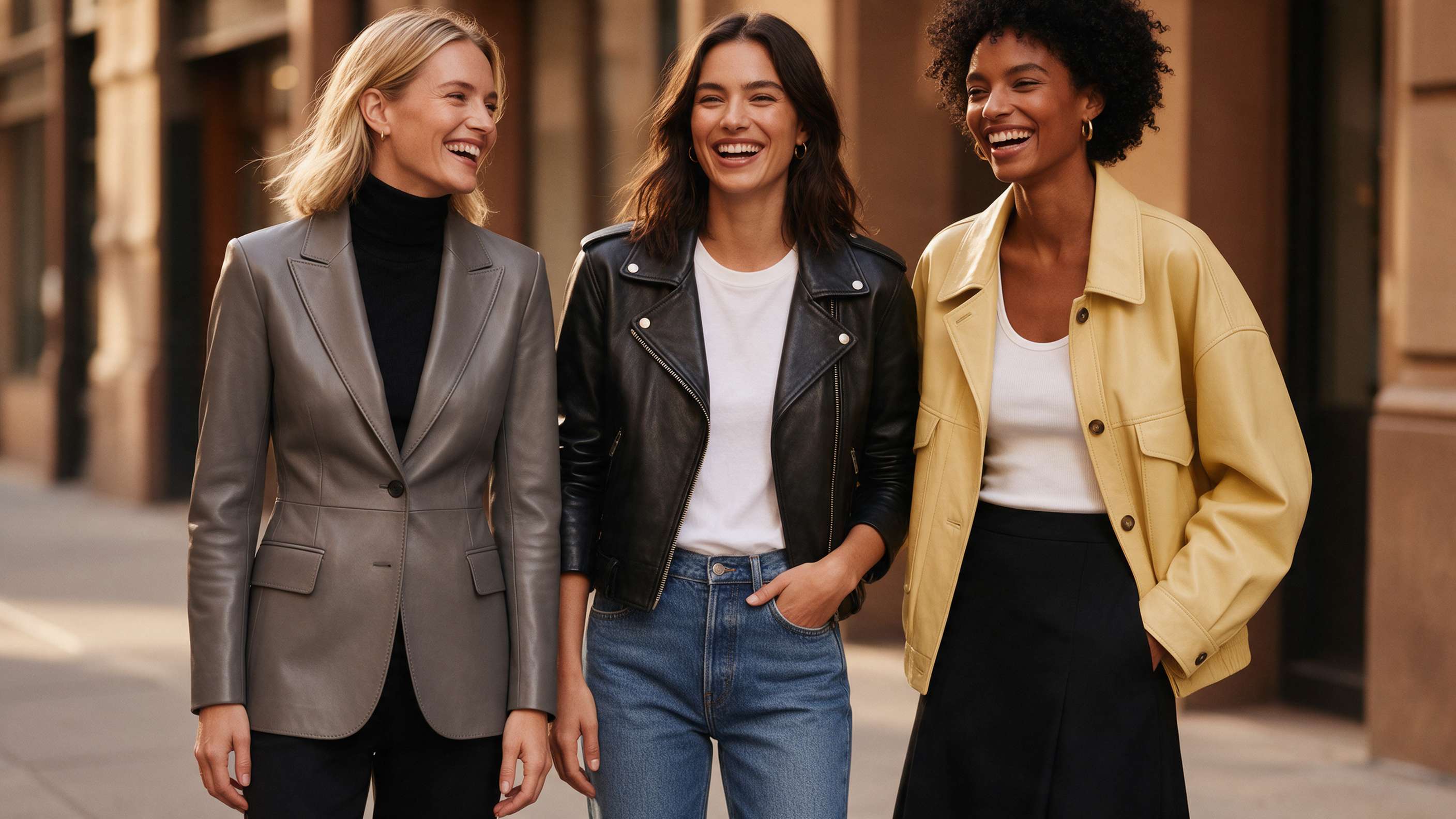
By the DLOOK Fashion Editorial Team
A leather jacket is the one fall purchase that never really leaves rotation — but the difference between "threw it on" and "styled it" comes down to two decisions most guides treat as an afterthought: the fit you choose and the fabric you buy it in. This guide is not a leather science class. We are not here to lecture you about tanning methods or hide grades; if you want that deep dive, a primer on the leather jacket's history and construction is a better starting point. What this article gives you is a working wardrobe system: twelve copy-paste outfit formulas built on a simple four-by-four matrix — four fits (fitted and chic, true-to-size classic moto, oversized, longline) crossed with four fall fabrics (real leather, faux leather, suede, and shearling-trimmed styles). Every formula below tells you where to wear it, exactly what to pair on top and bottom, which fabric and fit to pick, why the combination works, and how to test it on yourself first with the DLOOK virtual try-on before you commit.
Why the Leather Jacket Is Fall's Hardest-Working Piece
Every autumn the same thing happens: search interest for leather jackets climbs from late summer and peaks around late November, and every autumn a new wave of "how do I style this" questions follows right behind. The reason is simple. A leather jacket sits at a rare intersection — it is practical outerwear for transitional weather, it instantly raises the polish of everything underneath it, and it works across nearly every dress code from campus to client dinner. Fashion editors at Who What Wear publish updated leather jacket outfit roundups every single season because readers never stop looking for fresh formulas, and shopping guides like Elle's best leather jackets edit stay among the most-read fashion pages each fall. Outfit inspiration galleries from outlets like PopSugar consistently rank for the same reason: people do not want another product list — they want combinations that already work.
That is exactly what this guide delivers, with one upgrade the editorial roundups cannot offer: each formula ends with a virtual try-on prompt so you can see the full look on your own body and in your own closet context before you buy or wear it.
The Fit × Fabric Matrix: How to Use This Guide
Before the formulas, lock in the two axes. Your jacket's fit determines its silhouette and attitude; its fabric determines its texture, weight, price point, and care routine.
Fitted & chic — a tailored cut that follows the body: leather blazers, belted styles, and close-cut motos. Reads polished and intentional.
True-to-size classic moto — the iconic biker jacket as it was designed to fit: snug through the shoulders, hit at the hip, zero bulk. Timeless and versatile.
Oversized — dropped shoulders, extra room through the body, often borrowed-from-the-boys proportions. Fashion-forward and cozy for layering.
Longline — anything cut below the hip: leather trenches, long bombers, and shearling-trimmed aviator coats. Dramatic and warm.
Cross those with real leather (durable, molds to you, premium price), faux leather (affordable, lighter, easier care, improving fast in quality), suede (matte, soft, unmistakably autumnal), and shearling-trim (the warmest option, real or faux shearling lining and collars). The twelve formulas below deliberately cover every quadrant of the matrix — three looks per fit — so whatever is already hanging in your closet, you have a starting point.
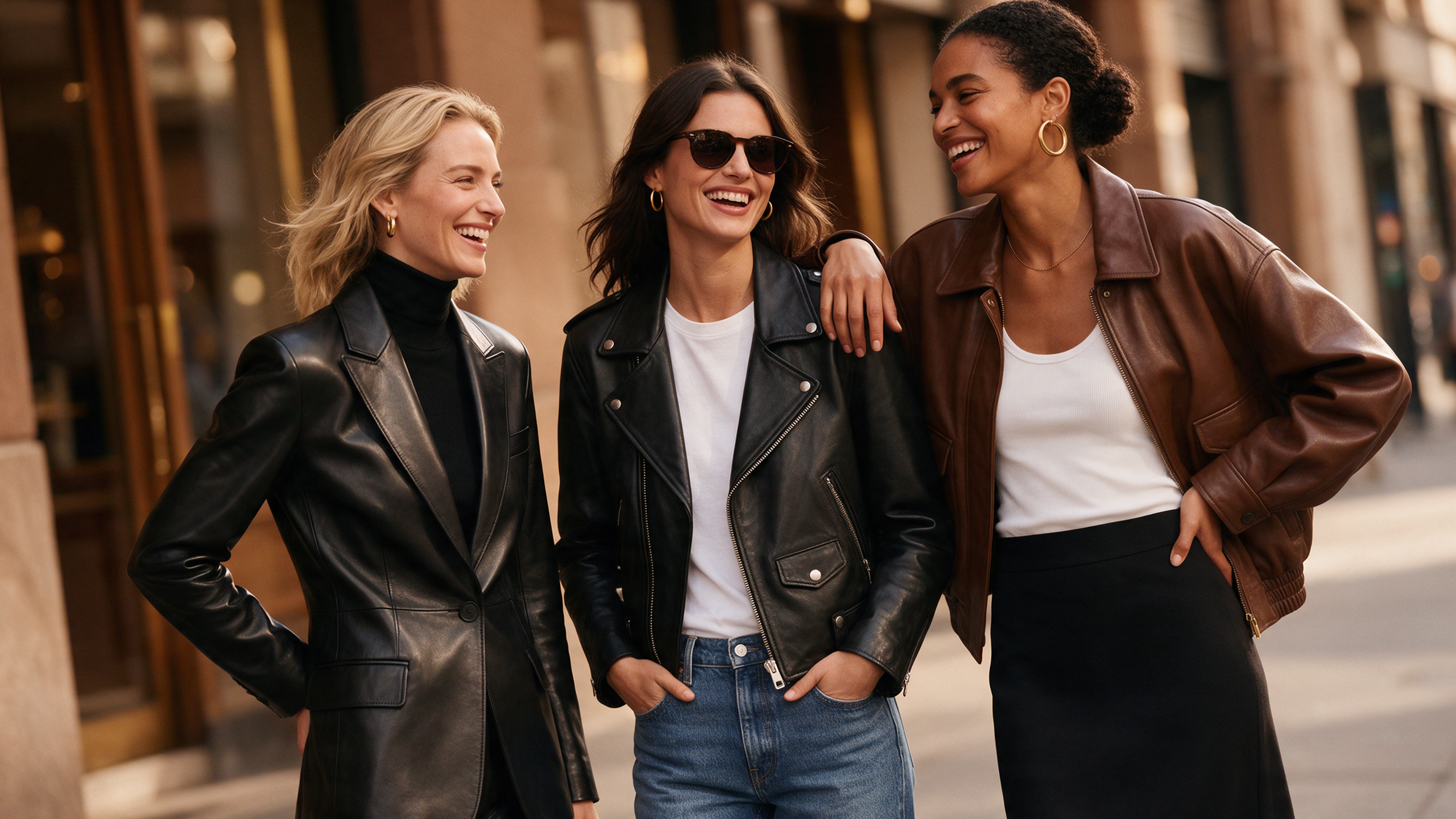
12 Leather Jacket Outfit Formulas for Fall
Fitted & Chic
Look 1: The Black Leather Blazer, 9-to-9
Occasion: office days that roll into dinner, client meetings, anywhere "smart" is the dress code.
The formula: a fitted black leather blazer over a white fine-gauge turtleneck, tucked into a black satin midi skirt, finished with black slingback heels and a structured leather tote.
Fabric and fit: this is the one look worth spending on real leather — a blazer-weight hide drapes and moves like tailoring, which is the whole point. Look for a fitted cut with a nipped or belted waist and a hem that ends at mid-hip.
Why it works: the blazer borrows the authority of a suit jacket while the leather adds edge; the satin skirt supplies shine and movement so the all-black palette never reads flat. The white turtleneck brightens the face and breaks the column just enough.
DLOOK try-on tip: blazer length versus skirt hem is the make-or-break proportion here. Run a virtual try-on with your actual skirt and turtleneck to confirm the blazer hem lands near the skirt's waistband, not floating over the hip.
Styling notes: swap the satin skirt for tailored trousers and the look turns fully corporate; swap in a silk camisole and it turns evening. Silver hardware reads cooler and more modern, gold reads warmer and more classic — match your jewelry to the jacket's zip tone and the outfit resolves itself. In the app, save two versions (skirt and trousers) under one outfit name so you can pull the right one for the day's calendar.
Look 2: Moto Over a Slip Dress
Occasion: date night, cocktails, concerts, any evening where you want effort without fuss.
The formula: a bias-cut slip dress in champagne or black, a fitted moto jacket worn open over it, strappy heels or knee-high boots, and a mini shoulder bag.
Fabric and fit: choose the softest leather you can find — real lambskin or a high-grade faux with genuine drape. The jacket must be fitted; an oversized cut here swallows the dress's line.
Why it works: this is the classic hard-versus-soft play. The slip dress is all fluidity and skin; the moto's zips and structure give it a spine. Wearing the jacket open keeps the dress visible and creates a long vertical line.
DLOOK try-on tip: try the jacket over two or three slip dress colors from your saved items — champagne reads romantic, black reads sleek, and a deep espresso brown is the sleeper hit of the season.
Styling notes: when it turns genuinely cold, layer a thin turtleneck under the slip dress rather than over it — the dress stays the focal point and the jacket still closes cleanly. Boots swap the mood: a knee boot makes it polished, a moto boot makes it tougher. Keep the bag small; a big tote breaks the evening line.
Look 3: Cropped Suede Jacket + High-Waist Trousers
Occasion: brunch, gallery afternoons, smart-casual Fridays — especially flattering on petite frames.
The formula: a cropped suede jacket over a cream fine-knit or bodysuit, high-waisted camel wide-leg trousers, pointed flats or loafers, and a small top-handle bag.
Fabric and fit: suede is the hero — its matte, napped surface is the visual opposite of shiny leather and instantly signals autumn. Keep the jacket fitted and cropped so it ends right at the trouser waistband.
Why it works: the crop raises the perceived waistline and the wide trouser extends the leg, a proportion trick that works on nearly every height. Cream and camel against tobacco or sand suede is a warm, expensive-looking palette.
DLOOK try-on tip: photograph your actual trousers into the app and test where the jacket hem falls relative to the waistband — a one-inch gap between jacket and waistband is the sweet spot.
Styling notes: suede shows texture, so keep the rest of the outfit smooth — a fine knit or a bodysuit beats a chunky cable here. If your suede is tan, try chocolate or cream trousers; if it is chocolate, try camel or off-white. The pointed flat is doing quiet work: it extends the trouser's line and keeps the wide leg from dragging.
True-to-Size Classic Moto
Look 4: White Tee + Straight Jeans + Boots
Occasion: the weekend uniform — errands, coffee, casual Friday, dinner at the neighborhood place.
The formula: a white crew-neck tee, mid-wash straight-leg jeans, black chelsea or moto boots, and a compact crossbody bag, all under a true-to-size black moto jacket.
Fabric and fit: this is the canonical moto, so fit it the canonical way: snug through the shoulders, sleeves ending at the wrist bone, hem hitting at the hip. Real leather molds to your shape over time; a good faux works if budget is tight.
Why it works: three colors — black, white, denim blue — and zero competition between pieces. The jacket is the statement; everything else is a clean stage for it. This is the outfit to reach for when you have ten minutes and want to look deliberate.
DLOOK try-on tip: build this as a saved "uniform" in your closet and cycle the tee and jeans through your real items — testing three jean washes against the same jacket takes under a minute.
Styling notes: this formula tolerates almost any swap — a striped tee for the white one, loafers for the boots — as long as the palette stays tight. The one upgrade worth making: a red lip or a red sock flash for color. It is also the best test outfit for a new jacket purchase, because if a moto cannot carry jeans and a tee, it will not carry anything.
Look 5: Brown Moto + Cream Knit + Wide-Leg Denim
Occasion: coffee dates, brunch, casual offices, leaf-peeping weekends.
The formula: a brown leather moto over a cream chunky knit, dark wide-leg jeans, loafers or block-heel ankle boots, and a tan leather tote.
Fabric and fit: brown leather — real or faux — in a true-to-size moto cut. Skip black here; the warmth of the brown is the entire mood. The knit should be fine enough to layer without straining the jacket's shoulders.
Why it works: brown, cream, and deep indigo is the most flattering warm-neutral combination of the season, and it photographs beautifully in autumn light. The moto's hardware keeps the soft knit from going too precious.
DLOOK try-on tip: brown leathers vary enormously — chocolate, cognac, tan. Virtually try your jacket against the cream knit to check the undertones flatter your personal color palette before wearing it out.
Styling notes: keep the knit short enough to half-tuck or end at the waist — a long untucked sweater under a moto cuts you in half. Cognac brown pairs with indigo denim; chocolate brown pairs better with cream and ecru. Match the tote to the jacket's brown family, not the shoes, and the outfit reads deliberate.
Look 6: Moto + Hoodie + Cargo Pants
Occasion: travel days, campus, city wandering, anywhere comfort leads.
The formula: a slim hoodie layered under a moto jacket, straight or tapered cargo pants, retro sneakers, and a nylon crossbody or mini backpack.
Fabric and fit: faux leather is the smart play — it is lighter, which matters when you are layering a hoodie underneath. Size the moto so the hoodie fits comfortably under it without pulling the seams.
Why it works: the moto's structure stops the hoodie-and-cargo combination from slumping into pure loungewear. It is a texture story too: matte fleece, smooth leather, rugged cotton twill.
DLOOK try-on tip: the common failure point is sleeve bulk. Run a virtual try-on with the hoodie under the jacket to confirm the sleeves still read clean and the collar sits right.
Styling notes: the hoodie should be slim-fitting and thin-to-medium weight — this is a layering piece, not a statement. Keep the hoodie neutral (gray, black, cream) so the jacket's hardware stays the detail. Cargo pants should taper or cuff at the ankle; pooling fabric over sneakers ruins the line.
Oversized
Look 7: Oversized Brown Leather + White Tank + Black Mini
Occasion: evenings out, gigs, parties — the street-style look that dominates every fall gallery.
The formula: an oversized brown leather jacket over a simple white tank, a black mini skirt, knee-high boots or heels, and a small clutch. Leather gloves optional but recommended.
Fabric and fit: this is the jacket to size up in — dropped shoulders, a boxy body, real leather if possible so the oversized shape drapes rather than tents. A slouchy faux leather works on a budget.
Why it works: volume on top demands restraint below. The mini and tank are deliberately minimal so the jacket's silhouette is the entire story; the brown-against-black contrast keeps it from reading like a costume.
DLOOK try-on tip: oversized jackets can visually shorten the leg. Try the look with both knee boots and heels in the app to see which restores the balance for your frame.
Styling notes: the tank should be fitted and fine — anything boxy under an oversized jacket adds bulk where you want none. If a black mini feels too bare for the occasion, swap in black straight-leg trousers and keep everything else identical; the jacket carries the look either way. The gloves are optional, but they are the detail that makes this formula feel styled rather than thrown on.
Look 8: Oversized Bomber + Gray Turtleneck + Wide-Leg Jeans
Occasion: campus, casual Fridays, weekend coffee — the easiest oversized formula to wear.
The formula: an oversized leather bomber in dark green or black, a fitted gray turtleneck tucked in, wide-leg jeans, chunky loafers, and a soft hobo bag.
Fabric and fit: faux leather keeps this affordable and light; the bomber's ribbed hem means even an oversized cut holds a shape. Size up one to two sizes from your usual.
Why it works: the turtleneck's fit contrasts the bomber's volume, and the wide jean echoes the jacket's relaxed line — a consistent loose-over-loose silhouette that still reads intentional because the waist is anchored.
DLOOK try-on tip: test two turtleneck necklines — a slim fold-over versus a chunkier rib — against the bomber collar in virtual try-on; the collar interaction changes the whole neckline.
Styling notes: dark green is the sleeper color here — it reads neutral the way black does but photographs richer against denim. Tuck the turtleneck fully; the bomber's ribbed hem marks your waist, so use it. Chunky loafers with a visible sock are the current way to finish this; a clean white sneaker works if loafers feel too dressy.
Look 9: Oversized Faux Leather + Leggings + Sneakers
Occasion: airport days, long train rides, coffee runs — travel comfort that still looks styled.
The formula: an oversized faux leather jacket over a fitted long-sleeve tee and black leggings or bike shorts, clean white sneakers, and a large soft tote.
Fabric and fit: lightweight faux leather is ideal here — it sheds wrinkles after hours of sitting and looks sharper than any hoodie. The oversized cut must fully cover the hip.
Why it works: leggings and sneakers are athletic; the leather jacket reframes them as a deliberate off-duty look. The jacket's drape supplies all the polish, so nothing underneath needs to work hard.
DLOOK try-on tip: pack this as a saved travel outfit and virtually test the jacket against both leggings and your travel jeans — seeing both on your body ends the "what do I wear" debate before the trip.
Styling notes: the tee should cover the seat, or choose a longerline tank — the jacket's hem and the tee should overlap cleanly, not meet in the middle. A crossbody bag worn under the jacket keeps everything secure for transit. If you run cold on planes, swap leggings for ponte trousers; the jacket handles the style either way.
Longline
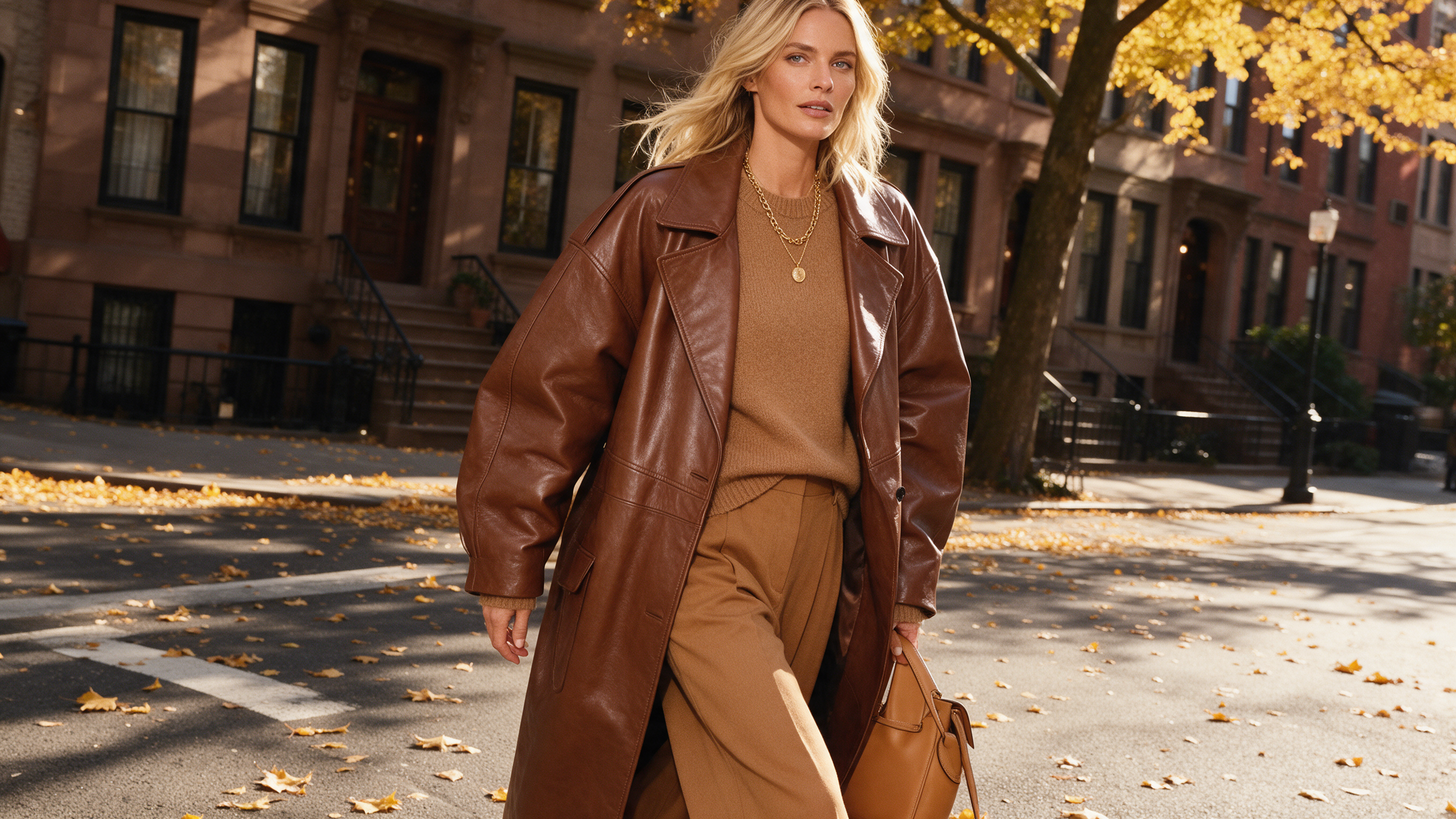
Look 10: Brown Leather Trench + Tonal Knit Set
Occasion: the office, dinners, events — the most elegant formula in this guide.
The formula: a long brown leather trench worn open over a matching chocolate knit top and knit midi skirt or trousers, heeled boots, and a structured bag.
Fabric and fit: a longline real leather trench is an investment; a quality faux in a fluid weight is a credible alternative. The coat should skim, not grip — check the shoulder seam and belt placement.
Why it works: tonal dressing — head-to-toe shades of one color family — is the oldest lengthening trick in styling, and a long coat multiplies it. The warm brown column flatters nearly every skin tone and happens to be the season's defining color story.
DLOOK try-on tip: coat length versus height is critical. Virtually try the trench over the knit set to check the hem hits mid-calf, not ankle — that single proportion decides whether the look sings.
Styling notes: keep the tonal family within two shades — top, bottom, and coat each slightly different — so the look has depth rather than reading as a uniform. If a full knit set is not in your closet, a chocolate knit dress does the same job with one piece. Belt the trench for structure when standing, open it for drama when walking.
Look 11: Shearling-Trim Longline + Jeans + Ankle Boots
Occasion: genuinely cold days — commutes, weekend markets, outdoor everything.
The formula: a longline aviator coat with a shearling collar and lining, a simple white or oatmeal knit, straight jeans, shearling-lined ankle boots, and a slouchy leather bag.
Fabric and fit: this is shearling's home turf. Real shearling is the warmest option in the matrix; faux shearling has improved enormously and costs a fraction. Keep the coat's body relaxed but not oversized — the shearling already adds visual volume.
Why it works: the shearling collar frames the face and the long cut blocks wind, so the outfit is genuinely functional. The texture mix — napped shearling, smooth denim, soft knit — reads rich without any pattern.
DLOOK try-on tip: shearling collars vary wildly in scale. Try your coat over different necklines — crew, turtleneck, open collar — to find which collar width balances your face and shoulders.
Styling notes: keep the layers under a shearling coat thin — the coat is the insulation, and bulk underneath defeats the fit. Straight jeans in a mid or dark wash balance the coat's volume; a slim jean works if the boots are substantial. Gloves in leather or suede echo the coat's texture story for the coldest days.
Look 12: Long Faux Leather Coat + Monochrome Base + Loafers
Occasion: rainy city days, museum afternoons, lunch meetings — practical polish for bad weather.
The formula: a long faux leather coat over a monochrome base — think all-gray, all-cream, or all-black knit and trousers — finished with loafers or waterproof ankle boots and a crossbody bag.
Fabric and fit: faux leather is the practical choice: it sheds drizzle, wipes clean, and does not water-spot the way suede or some real leathers can. Choose a longline cut with a clean, minimal collar.
Why it works: the monochrome column underneath makes the coat the picture frame, and the loafers keep the look grounded and walkable. It is the rare outfit that survives a downpour and still looks considered at the table.
DLOOK try-on tip: try the coat over three monochrome bases from your closet in one session — gray, cream, and black — and save the strongest. Base color changes this outfit's entire mood.
Styling notes: texture keeps monochrome from flattening — pair the coat with a ribbed knit, wool trousers, or a cotton poplin shirt so the single color still shows layers. Loafers with a rubber sole handle wet pavement; if the forecast is truly grim, a waterproof Chelsea boot swaps in without changing the look's character.
Fabric Quick Guide: Real vs Faux vs Suede vs Shearling
You do not need a materials science degree — you need four rules of thumb.
Real leather is the long game: it molds to your body, survives a decade of wear, and looks better with age. The trade-offs are price, weight, and the need for occasional conditioning. If you will wear the jacket three-plus times a week from October through March, real leather usually wins on cost-per-wear. This is the fabric to prioritize for your fitted blazer and classic moto — the two hardest-working silhouettes.
Faux leather has quietly closed the quality gap. Modern polyurethane and plant-based blends drape well, weigh less, cost a fraction, and clean with a damp cloth. It is the right call for trend-driven shapes — an oversized bomber you may not wear in three years — and for anyone avoiding animal products. Watch for two tells of cheap faux: a plastic shine and a stiff, papery hand feel.
Suede is the texture specialist. Matte, soft, and warm-toned, it does the heavy lifting in any outfit because nothing else in your closet looks like it. The catch is weather: suede hates rain and stains, so treat it with a protector spray and save it for dry days. A suede jacket is your third or fourth purchase, not your first.
Shearling-trim — a leather coat lined or collared in shearling, real or faux — is the warmth play. When temperatures drop below genuine jacket weather, this is the piece that lets you skip the puffer without freezing. Faux shearling delivers the look at a much lower price and is machine-friendlier; real shearling is a genuine winter investment.
Care, briefly: real leather wants a conditioner once or twice a season and a specialist cleaner for real stains — never a washing machine. Faux leather wipes down with a damp cloth and mild soap; store it on a wide hanger so it does not crease. Suede needs a protective spray before its first wear and a suede brush after every few wears. Faux shearling is usually machine washable on a gentle cycle (check the label); real shearling prefers airing out over washing. Ten minutes of care per season is the entire maintenance budget.
One practical note on shopping: brand search interest around leather jackets surges every fall across accessible and premium labels alike, which means stock in popular sizes moves fast. If a formula above convinces you, test the look virtually first, then buy early in the season rather than waiting for your size to disappear in November.
Fit Guide: How Each Fit Should Actually Fit
Fit questions are where most leather jacket regret begins, so here is the concrete checklist. Before shopping, measure two things with a soft tape: your shoulder width (seam to seam across the back, or around the fullest part of your upper arm for sleeve reference) and your preferred jacket hem point (hip bone versus waist). Bring those numbers — and, ideally, a photo of your most-worn outfit — to every try-on or virtual session.
Shoulders: the seam should sit exactly on your shoulder bone for fitted and true-to-size styles. For oversized, the seam should drop one to two inches down the arm — that drop is what creates the intended slouch.
Sleeves: fitted motos end at the wrist bone; oversized styles may run to the base of the thumb; longline coats should reveal a sliver of wrist or cuff.
Body: a true-to-size moto should zip without strain over a light sweater and feel snug — not tight — across the back. You should be able to hug someone without the jacket protesting.
Hem: classic motos and bombers hit at the hip bone. Cropped fitted styles end at the natural waist. Longline coats should end between knee and mid-calf — never at the widest point of the calf.
Layering test: always try the jacket over the thickest layer you realistically plan to wear under it. A moto that fits over a tee but strains over a hoodie is a size problem, not a layering problem.
Which fit for which body? As a starting framework, not a rulebook: fitted and cropped cuts define the waist and work beautifully on hourglass and petite frames; true-to-size motos are the universal donor — they look correct on nearly everyone; oversized cuts add presence and shoulder line to straighter frames, while anyone with a fuller bust should check that oversized lapels do not add unwanted volume at the chest; longline coats elongate every frame but demand correct hem length, especially under five-foot-four. Treat these as hypotheses and verify them on your own body — which is precisely what a virtual try-on session is for.
6 Common Leather Jacket Mistakes to Avoid
Buying oversized by accident. A moto that is simply two sizes too big is not "oversized" — it is ill-fitting. Intentional oversized means dropped shoulders and a designed boxy body; accidental oversized means pulling seams and sagging armholes.
Ignoring the layering test. The number one return reason in fall is a jacket that fits in the fitting room over a t-shirt and nowhere else. Try it over your real layers.
Shiny cheap faux. The plastic sheen is the fastest way to make a good outfit look inexpensive. Matte finishes read far richer at every price point.
All-leather everything. Leather jacket plus leather pants plus leather bag is a costume. Let the jacket be the only leather hero and mix textures — knit, denim, satin, cotton — everywhere else.
Wrong proportions with oversized fits. Volume on top needs slim or short lines below. An oversized jacket over wide-leg trousers and a long top swallows your shape entirely.
Skipping weather judgment. Suede in the rain, an unlined moto in near-freezing wind, a long faux coat on a blazing afternoon — match the fabric to the forecast and every outfit above works harder.
FAQ: Leather Jacket Outfits, Fit and Fabric
How should a leather jacket fit a woman?
For a classic moto, aim for snug: shoulder seams on the shoulder bone, sleeves ending at the wrist, hem at the hip, and enough room to zip over a light sweater. Fitted blazers should nip at the waist; oversized styles should drop one to two inches past the shoulder seam by design. If you plan to layer hoodies or chunky knits, verify the fit over those exact layers.
Are oversized leather jackets still in style?
Yes — the oversized silhouette has moved from trend to staple, especially in brown and dark green bombers and boxy motos. The key is intentional proportion: dropped shoulders and volume balanced by slimmer pieces underneath, like a fitted tank with a mini skirt or a tucked turtleneck with straight jeans.
What do you wear under a leather jacket in fall?
The five most reliable bases: a white tee or tank, a fine turtleneck, a slim hoodie for streetwear looks, a slip dress for evenings, and a chunky knit for cold days — the last one only if your jacket's fit accommodates it. Match the base's formality to the occasion and let the jacket supply the edge.
Is faux leather worth buying?
For trend silhouettes, layering pieces, and travel jackets, absolutely — modern faux leather drapes well, weighs less, and wipes clean. For the two hardest-working pieces in your wardrobe, a fitted blazer and a classic moto, real leather's durability usually justifies the higher cost-per-wear.
Can you wear a leather jacket in the rain?
Real leather tolerates light drizzle if you dry it naturally and condition it afterward; faux leather handles wet weather better and wipes dry. Suede is the exception — protect it with a spray and keep it for dry days. A long faux leather coat is the most rain-proof option in this guide.
What color leather jacket is most versatile?
Black remains the universal choice and the top of every outfit-search list. But brown — chocolate, cognac, tan — is the season's momentum color, flatters warm palettes, and anchors tonal looks. If you already own black, make brown your second jacket.
How do I know if a leather jacket outfit works on my body?
Check three proportions: jacket hem versus your waistline, sleeve length versus your wrist, and volume balance between top and bottom. The fastest way to test all three is a virtual try-on — upload or select the pieces, see the full look on your frame, and adjust one variable at a time before you commit.
The Bottom Line
Twelve formulas, four fits, four fabrics — the matrix is simple on purpose. Start with the fit you already own, run the matching formulas through a virtual try-on with your real pieces, and let the fabric guide decide what to buy next. A leather jacket should make every fall outfit feel finished; now you have the system to make sure it does.
Download the DLOOK app to virtual try on outfits, discover your perfect colors, and effortlessly manage your closet and looks.