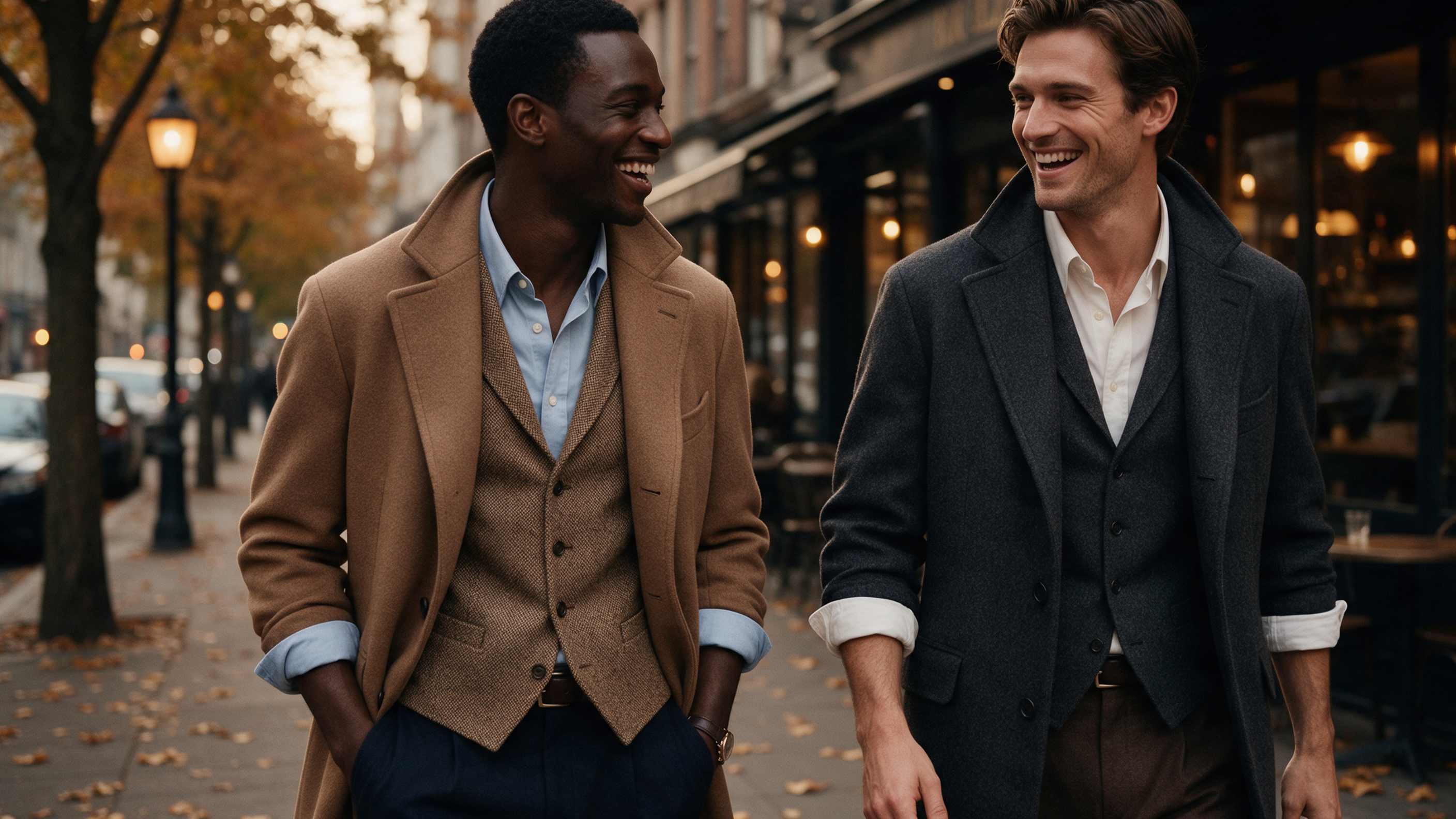
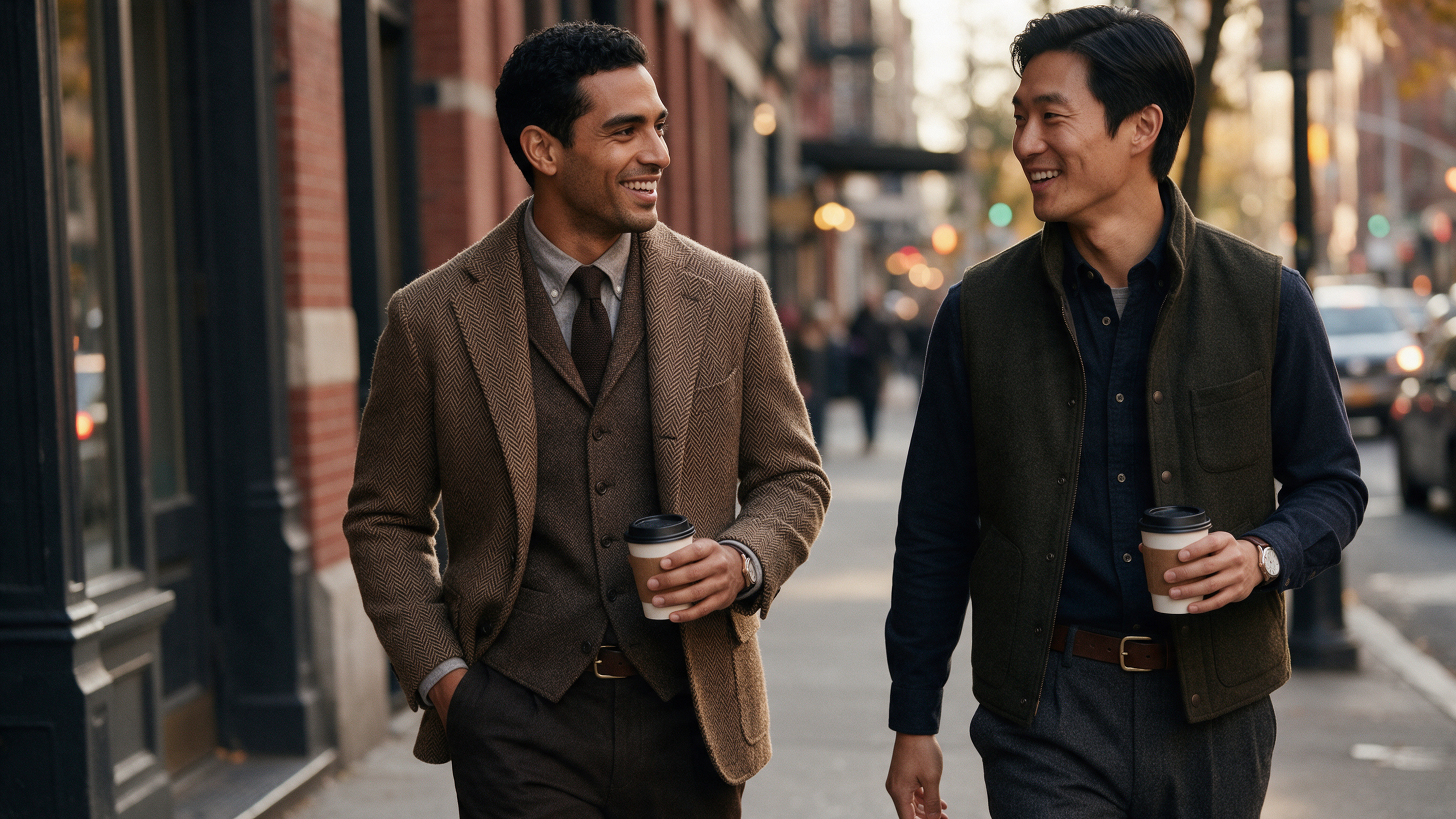
If you think a vest is something your grandfather wore to church, it's time to look again. The men's vest outfit has quietly become one of the most versatile moves in modern menswear — a single piece that can carry you from a black-tie wedding to a Saturday farmers market without missing a beat. Fall 2026 is peak vest season: searches for men vest outfit ideas, wedding styling, and winter layering are all climbing as American men rediscover what tailors have known for a century — the waistcoat is the fastest way to look intentional.
Why now? Three forces have converged. First, the return-to-office era has men rebuilding wardrobes that need to work harder, and a vest turns two pieces (shirt and trousers) into a complete outfit. Second, the "quiet luxury" and heritage-menswear trends have made tweed, flannel, and tailored wool cool again. Third, AI styling tools have made it effortless to test a vest outfit on your own photo before buying anything — you can see exactly how a charcoal waistcoat sits on your frame before it ships.
In this guide, we break down seven complete vest outfit formulas for every occasion on your 2026 calendar: weddings, formal and black-tie events, the office, date night, weekend casual with jeans, winter layering, and parties. Each one comes with exact styling rules, fabric and color guidance, and the small details that separate a polished look from a costume.
A note on how to use this guide: every formula below assumes you already own the basics — a white dress shirt, dark trousers, one pair of leather shoes. The vest is the multiplier, not the foundation. If a formula calls for something you don't own, that's your shopping list for the season, and each purchase will keep paying for itself across multiple formulas. Read the section for your next event first, then work through the fit and fabric chapters before you buy anything.
The Quick Answer: How Should a Man Wear a Vest in 2026?
For most occasions, the winning formula is simple: wear a fitted vest in a fabric that matches the formality of the event, keep the bottom button undone, and never let the vest flare away from your torso. For formal events, pair a matching three-piece waistcoat with a crisp dress shirt. For the office, a tweed or wool vest over an Oxford shirt works with or without a blazer. For weekends, a knit or quilted vest with dark jeans and boots is the modern casual standard. We'll expand each of these into full outfits below.
Vest vs. Waistcoat: What's the Difference?
The short answer: nothing — and everything. The entire waistcoat vs. vest debate comes down to geography. "Waistcoat" is the British term; "vest" is the American term for the same tailored sleeveless garment worn over a shirt and under a jacket. According to the Wikipedia entry on the waistcoat, the garment has been a standard component of men's formal dress since the late 17th century, when King Charles II of England introduced it as part of proper court dress.
In American usage today, "vest" also covers a broader family of garments: sweater vests, quilted outdoor vests, puffer vests, and utility vests. So when you search for a men vest outfit, you're often searching across two categories — the structured dress waistcoat and the more casual knit or padded vest. This guide covers both, because the smartest 2026 wardrobes include at least one of each.
One more distinction worth knowing: single-breasted versus double-breasted. A single-breasted vest with five or six buttons is the modern default and works in every setting on this list. A double-breasted waistcoat, usually with a shawl collar and peaked lapels, is a bolder, more vintage-flavored choice that shines at parties and race-day events but reads as too much in most offices. If you're buying your first vest, go single-breasted.
1. The Wedding Vest Outfit (Guest and Groomsman)
Fall is the busiest wedding season in the United States, and the single most searched vest question of 2026 is some version of mens vest outfit for wedding — followed closely by "do groomsmen wear vests?" The answer to the second question is a resounding yes, and here's why it works so well.
The Groomsman Formula
Groomsmen vests solve the oldest wedding-party problem: how to make five or six men look coordinated without forcing them into identical rented tuxedos. A matching waistcoat with dark trousers and their own white or light-blue dress shirts looks unified in photos, lets each groomsman wear a suit jacket for the ceremony, and — crucially — lets everyone ditch the jacket on the dance floor while still looking dressed. That's the practical secret venues love: the vest keeps the party looking sharp at hour six of the reception.
Vests also solve the budget problem. Renting a full tuxedo for each groomsman runs well over a hundred dollars per person, while a coordinated vest-and-trousers look built around pieces the groomsmen may already own costs a fraction of that — and unlike a rental, they get to keep a genuinely useful garment. Coordinate through shared fabric and color, then let each groomsman supply his own shirt, trousers, and shoes within your palette. The result photographs as one vision and fits six different budgets and body types.
The modern 2026 groomsman look:
Vest: Matching the groom's suit fabric — navy, charcoal, or dusty sage for fall weddings
Shirt: White or pale blue poplin, spread collar
Trousers: Matching the vest exactly (a true three-piece), or charcoal/navy dress trousers
Tie: Optional. A knit tie or no tie with an open collar both work for daytime ceremonies
Shoes: Brown or oxblood leather derbies for rustic venues; black Oxfords for hotel ballrooms
If you're the groom, consider inverting the formula: give the groomsmen plain suits and reserve a contrasting or patterned waistcoat for yourself. A burgundy or forest-green groom vest against navy groomsmen suits is one of the most photographed wedding looks of the season, and it requires zero extra effort from the wedding party.
The Wedding Guest Formula
As a guest, your vest should nod to formality without competing with the wedding party. A tan or light-grey linen-blend vest over a chambray or white shirt, with tobacco-brown chinos and loafers, is the ideal late-summer-to-fall guest look. For evening black-tie weddings, see the next section — a formal waistcoat is actually expected there.
What to avoid as a guest: white or ivory vests (reserved for the groom), anything shinier than the wedding party's outfits, and sleeveless-only formality at religious venues — bring a jacket you can put on for the ceremony. And always check the invitation's dress code first; "garden formal" and "black tie optional" call for very different vests.
For fall 2026 weddings specifically, lean into the season's palette: rust, caramel, olive, and deep navy vests all photograph beautifully against autumn foliage and golden-hour light. If the wedding is outdoors, choose a slightly heavier fabric — a flannel-backed wool vest — so you're not shivering through the cocktail hour. Indoor ballroom weddings call for smoother, lighter worsteds that won't overheat under the chandeliers.
2. The Formal and Black-Tie Vest Outfit
At the most formal end of the spectrum sits the black-tie waistcoat — the piece that most men under forty have simply never been taught to wear. The traditional black tie dress code, as documented on Wikipedia, specifies a dinner jacket (tuxedo) with either a waistcoat or a cummerbund, and the waistcoat is unquestionably the more elegant, more photogenic choice.
The rules here are strict, and following them is what makes the look powerful:
Fabric: Barathea wool or silk-faced lapels, always matching your tuxedo
Cut: Deep U-neck or horseshoe front, cut low to display the dress shirt's pleated or piqué bib
Buttons: Covered in the same fabric as the jacket — never horn, never metal
The bottom button stays undone. This tradition dates back to Edward VII and remains non-negotiable in 2026
Shirt: White, wing or turndown collar, with black studs and either a bow tie or an ascot
White-tie occasions — state dinners, ultra-formal galas, royal-adjacent events — go one step further with a white piqué waistcoat over a black tailcoat. You likely won't need this more than once a decade, but if the invitation says "white tie," the waistcoat is mandatory, not optional.
The most common black-tie vest mistake is buying one cut too high. A waistcoat that covers the shirt bib defeats the entire point of the garment; the deep U-neck exists to frame the shirt's texture. If you're renting, try the full ensemble on together — shirt, vest, jacket — because the proportions only work as a system.
Worth knowing: the cummerbund is the waistcoat's only formal rival, and the vest wins in almost every situation except the hottest summer weddings. A cummerbund is a wide pleated sash that hides the trouser waistband; it's cooler to wear but offers nothing structurally. The waistcoat actually improves your posture and silhouette, cinching the midsection the way a corset does — one reason men in three-piece formalwear photograph so well. If the invitation says "black tie optional," a dark navy or midnight-blue waistcoat with a tuxedo is the confident answer; if it says "creative black tie," that's your license for a subtly patterned or contrasting vest.
3. The Office Vest Outfit
The office is where the men vest outfit formal search intent lives, and it's where a waistcoat earns its keep. A three-piece suit communicates seniority and attention to detail — but the real 2026 office move is the two-and-a-half-piece: vest and trousers from the same cloth, worn with a contrasting blazer or no jacket at all.
The Modern Business Formula
Vest: Charcoal, navy, or mid-grey wool, cut close with a higher armhole
Shirt: Light-blue or white Oxford button-down for business casual; crisp poplin for formal offices
Tie: Silk knit for texture, or skip the tie and button the shirt's top button for a clean open look
Trousers: Matching the vest — this is what makes it look like a suit, not a costume
Shoes: Dark brown cap-toe Oxfords or Chelsea boots
Two office rules that separate the polished from the puzzled. First, if you remove your jacket at your desk, the vest must stay on — a vest-less dress shirt with suit trousers looks unfinished, while the vest makes the whole outfit read complete. Second, match your belt to your shoes and keep both dark. For a deeper dive into the mechanics of vest construction and formality levels, Real Men Real Style's waistcoat guide breaks down lapel styles, fabric weights, and when each is appropriate.
Business Casual vs. Fully Formal Offices
Match the vest's formality to your office's baseline. In law, finance, and consulting, stick to worsted wool waistcoats in navy or charcoal with a tie. In tech, media, and creative fields, a knit vest or tweed waistcoat over an Oxford with chinos hits the right note. The test is simple: if your boss wears a blazer daily, wear the tailored vest; if your boss wears a hoodie, reach for knit.
One more office advantage nobody talks about: the vest is the best travel garment in menswear. It survives a long flight without wrinkling the way a jacket does, it has pockets deep enough for a phone and boarding pass, and when you arrive at the client meeting you look composed even if your jacket spent three hours in the overhead bin. For the hybrid worker, that makes the vest the single hardest-working purchase of 2026 — one piece that upgrades every video call above the waist and every in-person day below it.
If you work somewhere with no dress code at all, the vest is still your friend — just shift the material. A cotton or knitted vest over a plain heavyweight tee, with relaxed chinos and canvas sneakers, borrows the vest's structure without its formality. It signals that you thought about your outfit, which in a hoodie-and-jeans office quietly sets you apart without a single word.
4. The Date Night Vest Outfit
Date night is where you can push the vest from "professional" to "interesting." The formula: rich texture, a little shine, and nothing that looks like you came straight from a conference room.
Vest: Burgundy, forest green, or midnight-blue velvet — or a deep-toned knit vest for more casual venues
Shirt: Cream, black, or fine-stripe shirt; roll the sleeves if it's a knit vest
Bottoms: Black or dark-indigo slim jeans, or charcoal wool trousers for upscale restaurants
Shoes: Black Chelsea boots or polished loafers — no sneakers unless the knit-vest version
Why velvet works so well after dark: it drinks in restaurant lighting instead of reflecting it, photographs beautifully, and signals effort without a tie. Keep jewelry minimal — a watch and that's it. The vest is already your statement.
Fit note for date-night vests: because there's no jacket to hide behind, the vest's back adjuster and hem length are fully on display. Have it tailored if the back fabric buckles when you cinch it. A $30 alteration transforms an off-the-rack vest into something that looks bespoke across a dinner table.
Venue matters more than most men expect. At a candlelit cocktail bar, go velvet and dark. At a casual rooftop or brewery date, swap to a fine-gauge knit vest with rolled sleeves and clean white sneakers. At an upscale restaurant with a dress code, a wool waistcoat with charcoal trousers and a knit tie strikes the ideal balance — dressed up, but visibly more stylish than the sea of plain suits around you. When in doubt, match the vest to the venue's lighting: shiny fabrics for dim rooms, matte textures for bright ones.
5. The Weekend Casual Vest Outfit (With Jeans)
This is the outfit that converted a generation of skeptics. Mens vest outfit with jeans is one of the fastest-growing vest searches of 2026, and the answer is a tweed or wool vest worn deliberately casual.
The City-Weekend Formula
Vest: Brown, olive, or grey tweed or lambswool — heritage fabric, modern cut
Shirt: White or ecru Oxford, sleeves pushed up, top button open, or a grey marl crewneck tee underneath
Jeans: Dark indigo, straight or tapered — no distressing, no fades. The vest is doing the talking
Shoes: Tan suede chukka boots, white leather sneakers (minimal, clean), or brogue boots
Optional layer: An unstructured field jacket or chore coat over everything when the temperature drops
The key to wearing a vest casually is contrast. A heritage tweed vest looks current against clean, minimal basics — not paired with more heritage pieces, which tips into costume. One vintage-feeling item per outfit is the rule. And fit matters more here than anywhere: a casual vest should still skim the torso, ending right at the belt line, with armholes high enough that the whole piece moves with you.
Footwear is where most casual vest outfits succeed or fail. Suede and leather boots ground the tweed and keep the look autumnal; clean white leather sneakers make it modern and city-ready; running shoes or beat-up trainers drag the whole outfit down. The same logic applies to color: a brown or olive vest wants tan or brown shoes, a grey vest wants black or dark brown. Echo the vest's warmth somewhere below the waist and the outfit reads as considered rather than assembled.
The Sweater Vest Variant
Learning how to wear a vest men casual in 2026 means mastering the sweater vest. The revived knit vest works best layered, not solo: try a cream cable-knit vest over a white tee with ecru trousers and suede sneakers, or a dark-green fine-gauge knit vest under an open flannel shirt. Keep the knit vest one size closer than you think — baggy knit reads sloppy, while a close knit reads deliberate. Avoid argyle unless you're deliberately leaning into the academia trend, and pair it with plain everything else.
6. The Winter Layering Vest Outfit
When temperatures drop, the vest shifts from style piece to strategy. Men vest outfit winter styling is really about building heat-trapping layers that still look sharp when the coat comes off indoors.
The Cold-Weather Formula
Base: A fine merino turtleneck or thermal henley — thin, warm, and smooth under layers
Vest: A tailored wool waistcoat for dressed-up days, or a quilted/down vest as the outermost layer for casual days
Mid layer: A heavyweight flannel shirt or chunky cardigan between base and vest when it's truly cold
Outerwear: A wool overcoat or parka long enough to cover the vest's hem
Bottoms: Dark wool trousers or black jeans; cold-weather leather boots
Color strategy for winter: build from the same tonal family — charcoal, black, and heather grey layer seamlessly, and a camel or rust vest becomes the single warm accent against them. Avoid the rookie mistake of a puffy vest over a bulky sweater; the layers should graduate thin-to-thick from the body outward. For step-by-step layering mechanics and vest proportion rules, Ties.com's guide on wearing a vest is one of the most practical references we've found.
Why layering beats bulk: a tailored waistcoat over a merino turtleneck traps warm air at your core — where it matters — while keeping your arms free and your silhouette intact. It's the same reason cyclists and hikers vest-layer, translated into menswear. When you step indoors, you shed the coat and the outfit underneath is complete, not a crumpled mess of sweater.
The finishing touches separate a winter vest outfit from merely staying warm. A wool scarf in a complementary tone, looped once and tucked into the coat, adds depth at the neck; leather gloves echo the belt and boots; and a beanie in a matching neutral keeps the top of the outfit coherent when the coat is closed. Skip the trap of wearing every warm thing you own at once — in winter layering, restraint reads as sophistication, and two or three well-chosen layers beat five chaotic ones every time.
7. The Party and Statement Vest Outfit
Holiday parties, gallery openings, New Year's Eve — occasions where a suit feels stiff and a sweater feels lazy. This is the velvet vest's home turf, and it's where how to wear a vest men casual reaches its most expressive form.
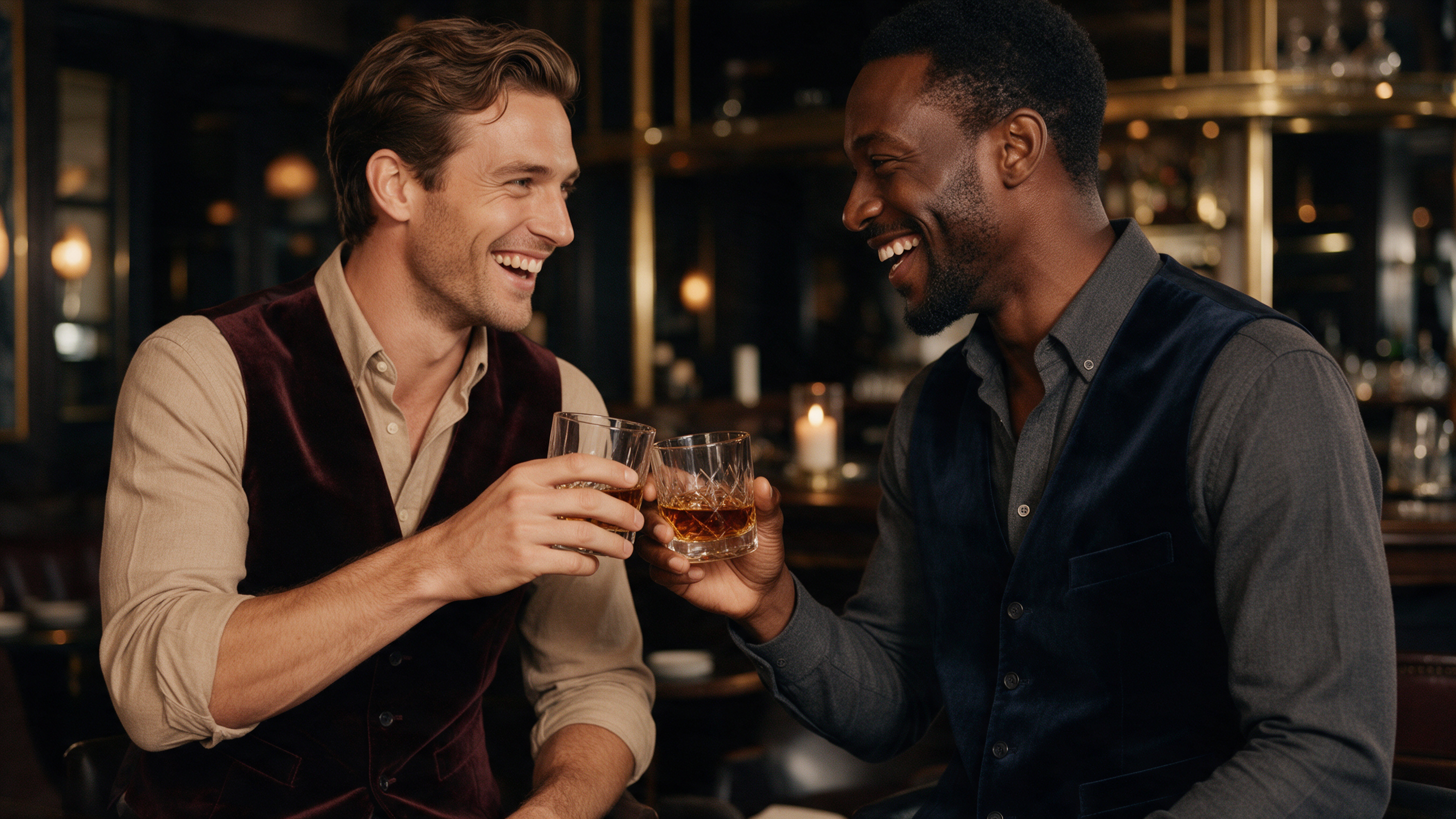
Vest: Velvet in burgundy, emerald, or black; satin-back evening waistcoats for true black-tie-adjacent parties
Shirt: Black silk-blend shirt (fully buttoned, no tie), or crisp white with the collar open
Bottoms: Black tailored trousers — the safest, sleekest partner for a loud vest
Shoes: Patent loafers or polished black Chelseas
Finish: A pocket square in a muted tone, worn nonchalantly
The styling math of a statement vest is simple: the vest carries 80% of the outfit's personality, so everything else drops to neutral. If your vest is patterned — brocade, jacquard, a bold plaid — keep the shirt solid and the trousers dark. If the vest is a rich solid like velvet, you can risk a subtly patterned shirt. Never compete with your own vest.
Timing and proportion complete the party look. A statement vest works best after sunset; in daylight, velvet can read theatrical. Keep the trousers trim — a wide or baggy trouser fights the vest's vertical lines — and let a centimeter of shirt cuff show past the vest's armhole, exactly as you would with a jacket. If the party runs long into the night, the vest becomes your best asset: jackets come off, and while everyone else looks like they undressed, you still look like an outfit.
The 2026 Vest Capsule: Building Your Rotation
You don't need seven vests — you need three, chosen deliberately. A capsule rotation covers every occasion on this list with zero redundancy.
Vest 1 — The Formal Workhorse: A charcoal or navy worsted wool waistcoat, bought with matching trousers. This covers the office, business events, formal weddings, and any day you need to look authoritative. It's the highest cost-per-wear item in this entire guide.
Vest 2 — The Texture Piece: A brown, olive, or grey tweed or lambswool vest. This carries weekends, casual weddings, winter layering, and any smart-casual invitation. Its job is contrast: wear it against clean tees, white Oxford shirts, and dark jeans.
Vest 3 — The Personality Piece: A velvet evening vest in burgundy, emerald, or black — or a knit vest if your life skews casual. This is your date-night and party vest, the one that gets remembered.
Buy all three with fit as the first criterion, not the label. A $120 vest tailored for $30 will outperform a $500 vest off the rack, every single time. And before committing, try the outfit on virtually — upload a photo to a styling app like DLOOK and test each vest against the shirts, trousers, and shoes you already own, so every purchase slots straight into outfits you've already verified.
Vest Care: Keeping It Sharp for Years
A well-made vest outlasts most of your wardrobe if you treat it right. Wool and tweed vests need dry cleaning only two or three times a year — over-cleaning breaks down the fibers. Between cleanings, brush the fabric after wear with a soft garment brush to remove dust and refresh the nap. Velvet demands gentler handling: never iron it directly, never hang it on a thin wire hanger (the shoulders will deform), and always steam rather than press. Hang every vest on a wide, shaped wooden hanger that supports the shoulder line, and give it 24 hours of rest between wears so the fabric recovers its shape. Finally, empty the pockets at the end of each day — a perpetually stuffed watch pocket will bag out the vest's clean silhouette faster than anything else.
How to Choose the Right Vest: Fit, Fabric, and Color
Across all seven outfits, three fundamentals decide whether your vest looks expensive or accidental.
Fit Rules
Shoulders and armholes: High and close — you should feel the fabric when you reach forward
The hem: Must cover your waistband completely and end at the belt line, never below it
The back adjuster: Use it. A proper cinch at the back waist is what creates the clean, tapered silhouette
Button stance: The top button should sit at your natural waist, not at your chest
Fabric by Occasion
Worsted wool: Suits, offices, formal events — the dressiest option
Tweed and lambswool: Weekends, country weddings, winter layering
Velvet: Evenings, parties, date nights
Cotton and linen: Summer weddings and warm-weather casual
Knit (sweater vest): The most casual tier — campus, weekends, creative offices
Color Strategy
Your first vest should be charcoal, navy, or mid-grey — it will pair with everything you own. Your second should add warmth: tan, brown, or olive. Only after those two workhorses should you venture into burgundy, green, or pattern. And one color note that applies to every vest outfit in 2026: brown footwear has fully returned to formal menswear, so don't default to black out of habit — match the shoe to the trouser and the occasion, not to a decade-old rule.
The Seven Formulas at a Glance
Wedding: Matching waistcoat + white/blue poplin shirt + dress trousers + derbies or Oxfords
Black tie: Tuxedo-matching waistcoat, deep U-neck, covered buttons, bow tie, bottom button open
Office: Charcoal wool vest + light-blue Oxford + matching trousers + cap-toes, knit tie optional
Date night: Velvet vest + black silk shirt + dark jeans or wool trousers + Chelsea boots
Weekend: Tweed vest + white tee or Oxford + dark indigo jeans + suede chukkas
Winter: Merino turtleneck + wool waistcoat + overcoat + wool trousers + leather boots
Party: Statement velvet or brocade vest + black shirt + black tailored trousers + patent loafers
The Five Mistakes That Ruin a Vest Outfit
Buttoning the bottom button. Always undone, no exceptions — the garment is cut for it
Wearing a vest without a belt (or with a mismatched one). The vest ends at the waistband, and the transition point draws the eye; make it clean
The orphan vest. A vest from one suit worn with trousers from another almost never matches; buy vests as part of a coordinated set
Too-long hems. A vest covering the entire seat makes your legs look short; the hem belongs at the belt
Over-accessorizing. Pocket square, lapel pin, tie bar, and a bold watch with a vest is four statements fighting; choose one
Frequently Asked Questions About Men's Vest Outfits
Waistcoat vs. vest — which word should I use?
They refer to the same garment. "Waistcoat" is the traditional British and tailoring-industry term; "vest" is standard American English. In the U.S., "vest" can also mean sweater vests and outdoor vests, so context matters when shopping.
Do groomsmen wear vests?
Yes — matching vests are one of the most popular groomsmen styling choices for 2026 weddings. They create a coordinated look in photos, work with or without jackets, and keep everyone looking dressed even late into the reception.
Can you wear a vest without a jacket?
Absolutely, provided the vest is tailored and the trousers match or deliberately contrast. A matching vest-and-trousers combination without a jacket reads as intentional modern style; a lone orphan vest with unrelated trousers often reads as a mistake.
Should the vest match the suit exactly?
For formal and business settings, yes — the waistcoat should be cut from the same cloth as the jacket and trousers (a true three-piece). For casual outfits, contrast is encouraged: tweed vest, dark jeans, plain shirt.
Is the bottom button of a vest really supposed to stay open?
Yes. The tradition is attributed to Edward VII and remains the standard rule of tailoring in 2026. Every tailored vest is cut assuming the bottom button is undone — buttoning it pulls the fabric out of shape.
Are sweater vests still in style for men in 2026?
Yes — the sweater vest has settled into a permanent place in the casual wardrobe after its 2020s revival. Wear it over a plain tee or Oxford shirt with jeans or chinos, and size it slightly relaxed rather than skin-tight.
What shirt should I wear under a vest?
Formal and office vests call for a dress shirt in white, light blue, or fine stripe. Casual knit vests work over tees, henleys, and Oxford shirts. The shirt collar should always sit inside the vest's neckline, never over it.
Can you wear a vest with shorts?
Generally no — the vest is a vertical, torso-lengthening garment and shorts break that line at the knee. The one exception is a casual knit vest with tailored shorts and loafers at a resort; even then, a short-sleeve shirt alone usually looks better.
How many buttons should a men's vest have?
Five or six for a standard single-breasted waistcoat — enough buttons to shape the torso without crowding it. Formal evening waistcoats often have four. Fewer than four buttons tends to look like a fashion experiment rather than tailoring.
Should I buy my vest with the suit or separately?
With the suit, whenever possible. Fabric batches vary, and a "matching" navy bought six months later rarely matches. If you're adding a vest to an existing suit, bring the jacket to the store and compare under daylight.
What shoes work best with a vest outfit?
Match the shoe to the occasion and the trouser. Oxfords and derbies for formal and office settings, Chelsea and chukka boots for smart-casual and winter, loafers for summer weddings and date nights, and clean minimal sneakers only with the most casual knit-vest looks. Keep the belt in the same color family as the shoe.
Can big or tall guys wear vests?
Better than almost anyone. The vest creates a long, unbroken vertical line from shoulder to waistband, which lengthens the torso and defines the midsection — the two things larger frames benefit from most. Choose a slightly longer cut that fully covers the waistband, and have the back adjuster tailored rather than maxed out.
Whether you're dressing for a fall wedding, rebuilding your office wardrobe, or just want one piece that makes jeans look intentional, the vest is the highest-leverage garment of 2026. Master the seven formulas above, respect the fit and button rules, and one small sleeveless layer will quietly upgrade everything you own — season after season, occasion after occasion, without ever asking for attention it hasn't earned.
Written by the DLOOK Fashion Editor Team. Our editors track menswear trends, tailoring rules, and seasonal styling data to publish practical outfit guides for real wardrobes.
Download the DLOOK app to virtual try on outfits, discover your perfect colors, and effortlessly manage your closet and looks.